
Custom Perfume Manufacturing: The Quality Control Checkpoints That Matter
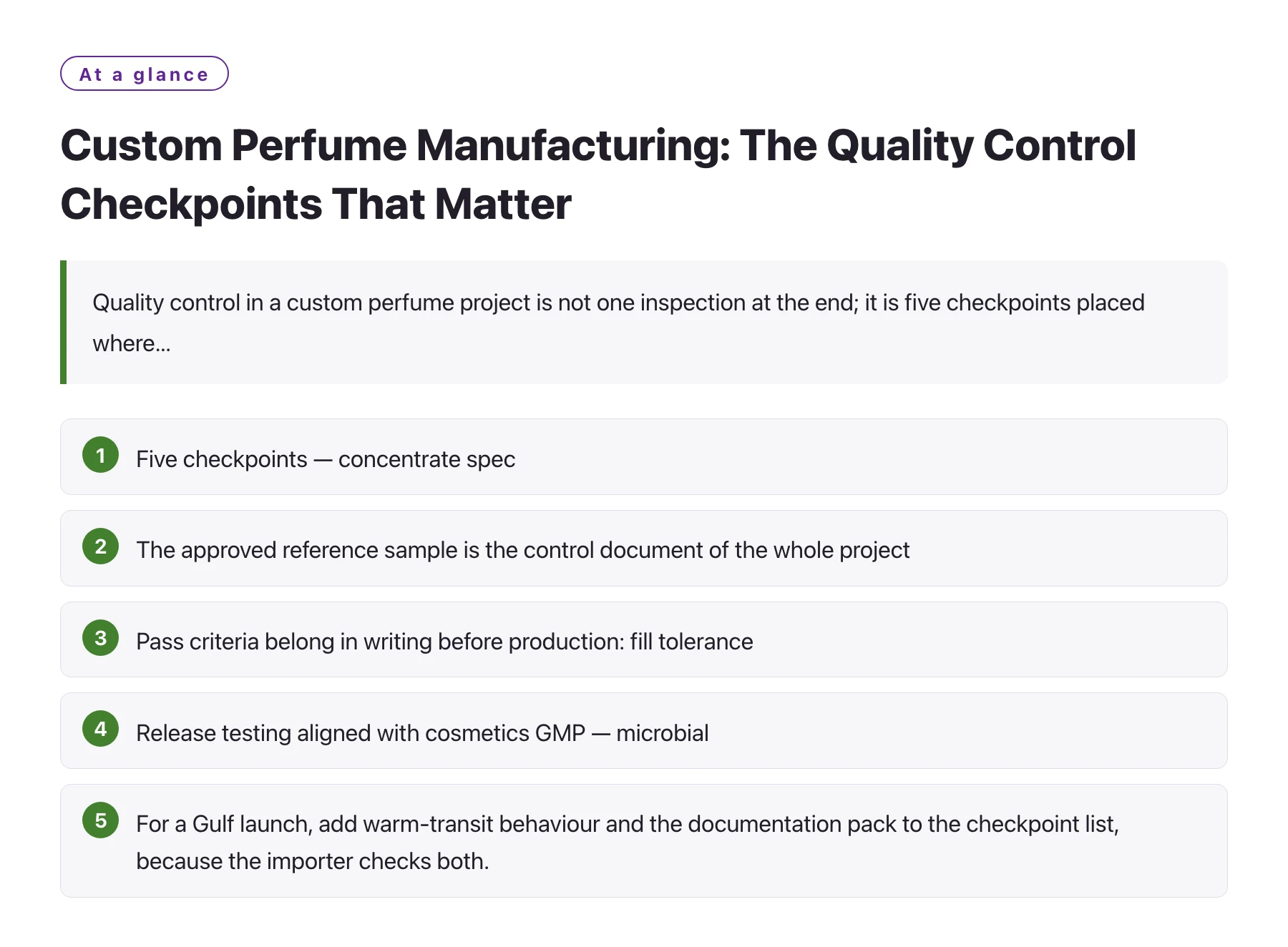
Quality control in a custom perfume project is not one inspection at the end; it is five checkpoints placed where failures actually start. The concentrate spec, the compounding record, the maturation reference, the filling data and the release test each catch a different class of problem, and each needs its pass criteria written before the project starts. For a brand commissioning a bespoke scent, the value of these checkpoints is that they turn "trust the factory" into "verify the evidence" — the only way to scale a launch without babysitting every batch.
Key takeaways
- Five checkpoints — concentrate spec, compounding, maturation, filling, release — catch different failure classes, and none of them is optional for a brand that wants repeatable batches.
- The approved reference sample is the control document of the whole project; everything downstream is compared with it.
- Pass criteria belong in writing before production: fill tolerance, closure torque and release-test limits are numbers, not adjectives.
- Release testing aligned with cosmetics GMP — microbial, stability and fill checks — is what turns a finished batch into a shippable one.
- For a Gulf launch, add warm-transit behaviour and the documentation pack to the checkpoint list, because the importer checks both.
Custom perfume projects fail in one of two ways: the scent is wrong, or the batches are inconsistent. The first is visible in a sample round; the second only shows up when a customer returns a bottle months later saying it smells different from the first one they bought. The second failure is a quality-control failure, and it is entirely preventable with checkpoints.
This article maps the checkpoints of a custom project the way a quality lead would set them up — from the first concentrate spec to the release of a production batch — with the question a buyer should ask at each one.
The five checkpoints, and the failure each one catches
- Concentrate specificationThe spec sheet is where quality starts: strength, ethanol ratio, formula reference, restricted-material handling. The failure it catches is ambiguity — a concentrate with no written spec cannot be reproduced.
- Compounding and batch recordLot numbers, weighings, signatures. The failure it catches is drift: a batch that repeats the formula loosely becomes visible here, not on the shelf.
- Maceration and the matured referenceThe settled concentrate is the approval standard. The failure it catches is premature approval that locks a moving target — a sample drawn before maturation.
- Filling and closure dataFill weight, closure torque, decoration match. The failure it catches is inconsistency at the unit level, the kind that reaches customers one bottle at a time.
- Release testing and the fileMicrobial, stability and fill checks plus the document pack. The failure it catches is the batch that was never actually verified before it shipped.
Checkpoint questions for the buyer
| Checkpoint | Question to ask | Pass signal |
|---|---|---|
| Concentrate spec | Does the spec sheet name strength, ethanol ratio and restricted materials? | A document, not a verbal description |
| Compounding | Can I see the batch record of the last run? | Lot numbers, weighings, signatures |
| Maturation | What is the approval reference, and when was it drawn? | A dated, sealed reference taken after maturation |
| Filling | What are the fill and closure torque tolerances? | Numbers in writing, with data per batch |
| Release | What tests does release run, and who signs it? | A test report with a named signatory |
A pass signal that is a document costs nothing to request and reveals more about the factory than a day of touring. Ask for the evidence at the meeting, not after it.
Where custom projects actually break
The checkpoint list assumes the factory runs the tests truthfully, and the most common gap in practice is release testing that exists on paper but not in behaviour. Alignment with cosmetics GMP practice — microbial, stability and fill checks on the batch — is the artefact a buyer should ask to see, and a factory that shows a real report for a real batch is demonstrating the habit rather than the brochure [1]. The stages and tests of the manufacturing process, including safety testing in perfume manufacturing safety testing in perfume manufacturing, are exactly what the release checkpoint should mirror.
Label documentation belongs to the same gate. For lines sold into or mirrored against EU requirements, the labelling of declared fragrance allergens follows thresholds set out in the opinions of the EU's consumer-safety committee, so the label should be checked against those obligations as part of release rather than discovered at the retailer [2].
The retained sample as the last checkpoint
The sealed reference of every released batch, held by both parties, is the checkpoint after the checkpoint. It is the artefact that settles the "this smells different" complaints that begin months after launch, and it costs nothing compared with the argument it prevents.
Where the checkpoints live in the process
The checkpoints work best when development and production share one quality system, because then the spec from the first stage survives into the last. That is precisely the arrangement behind a factory that handles fragrance R&D and production a factory that handles fragrance R&D and production under one roof — and it is why the first question a quality lead asks is about the handoffs, not about the machines.
Checkpoint rule: if the factory cannot show the evidence of the previous checkpoint at the next meeting, the process is running on memory, not on records. Memories scale badly; records scale.
What a Gulf launch adds to the checklist
Two additions matter for a Middle East launch. First, warm-transit behaviour: the closure and the concentrate both face summer logistics that laboratory conditions never reproduce, so a transport test becomes a sixth, unofficial checkpoint. Second, the documentation pack: the importer expects the file before the first order, which makes the release file part of the product rather than an afterthought.
When the checkpoints above are run from the first spec to the release file, the whole arc is what separates a craftsmanship project from a production process — the profile worth looking for in bespoke fragrance development and production bespoke fragrance development and production. A manufacturer that can walk you through its own checkpoint evidence from an earlier batch is showing you the system you will inherit.
Sources
- SGS: Cosmetics, Personal Care & Household Testing —— Testing, inspection and certification services for cosmetics and personal care, including microbiological, stability and safety testing aligned with cosmetics GMP.
- EU Scientific Committee on Consumer Safety (SCCS) —— The EU scientific committee that issues opinions on the safety of cosmetic ingredients, including fragrance allergens and their labelling thresholds.
Frequently asked questions
What are the most important quality control points in custom perfume manufacturing?
The concentrate specification, the compounding batch record, the matured reference sample, the filling and closure data, and the release test. Each one catches a different failure class, and the batch record is the backbone of the whole trail.
How do I know a factory's release testing is real?
Ask to see a test report for a specific, named batch — microbial, stability and fill checks aligned with cosmetics GMP — and check that the report carries a signatory. A real report for a real batch is the habit; a template is just paperwork.
What is the role of the retained sample in quality control?
It is the control document of the project: a sealed physical reference of the approved batch, held by both sides and used to settle any later dispute about whether a batch matches the approval.
Does quality control change for a Middle East launch?
A Gulf launch adds warm-transit testing and the documentation pack to the checkpoint list, because summer logistics stress closures and concentrates, and the importer expects the file before the first order ships.
Who should sign off each checkpoint?
Someone named, in writing — the operator at compounding, the quality lead at release. A named signatory is what makes a checkpoint a control rather than a rubber stamp, and it is the detail that survives an audit.