
Mining Wallets: Hot, Cold and Custodial Trade-Offs
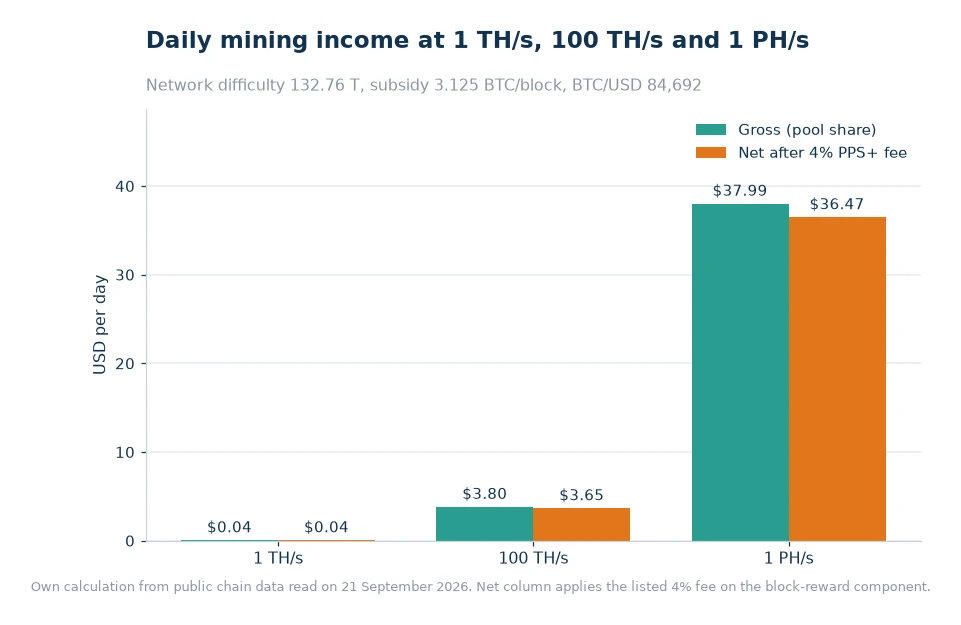
Every mining payout has to land somewhere, and the destination decides how many times you touch a private key, how quickly you can pay an electricity invoice, and how much yield gets spent moving coins between places. At 1 PH/s, gross income is about $37.99 a day — $1.58 an hour — and roughly $13,868 a year at a $84,692 BTC price. Whether that arrives in a custodial account balance or in a hardware wallet is a design choice, not a detail.

Key takeaways
- Settlement frequency sets the record count: PPS+ pays hourly, which is 24 payouts a day and 8,760 a year for an account that never pauses.
- Value scales fast with hashrate — $3.80 a day at 100 TH/s, $37.99 at 1 PH/s, $759.87 at 20 PH/s at today's difficulty of 132.76 T.
- Zero-fee mining payouts plus Auto Conversion inside one account remove two transfer steps from the path between hashrate and spendable money.
- Custody is a trade, not a ranking: a custodial balance settles fastest, self-custody removes counterparty exposure, and hardware storage slows everything down in exchange for key control.
The short answer
Choose the destination by how often you move money, not by ideology. A miner paying power and hosting monthly needs fast access to settlement; a long-term accumulator cares more about key control than about spending speed. Most operations end up using two destinations at once: a working balance for operating costs and a separate location for accumulation.
The cost of getting this wrong is rarely catastrophic, which is why it goes unexamined. It shows up as conversion spread, transfer fees and time spent reconciling wallets — small per month, meaningful against a gross figure of $37.99 a day.
How the mechanism works
Three stages sit between a share and a spendable balance. First, the pool converts shares into income: under PPS+ the block-reward component settles per share at a listed 4% fee and pays hourly against current difficulty, while the transaction-fee component follows PPLNS logic at a listed 2%. Under PPLNS both components merge at a listed 2% and distributions arrive after a block receives 6 confirmations, measured over the last 5 difficulty rounds.[1]
Second, the payout rail moves that income into your account. A pool such as ViaBTC Bitcoin Mining keeps mining payouts free of withdrawal fees, which matters because a payout that costs money to receive is a cost you cannot avoid paying. Third, the destination holds it — and that is where the trade-offs live.
| Destination | Who controls the keys | Time to availability | On-chain moves per year | Main exposure |
|---|---|---|---|---|
| Custodial balance inside the mining account | The provider | Immediate on settlement | 0, unless you withdraw | Counterparty |
| Self-custody hot wallet | You, on a connected device | One transaction | 12 monthly sweeps | Device compromise |
| Hardware wallet (cold) | You, on an offline device | One transaction plus device access | 12 monthly sweeps | Operational error and lost access |
The middle row is the one that trips people up. Sweeping monthly at 1 PH/s means moving about 0.0135 BTC a month, worth roughly $1,139.80, and doing so means paying network fees and waiting for confirmation — plus a delay if a transfer is stuck during congestion. A platform's own multi-currency wallet supports deposit, withdrawal and Auto Conversion next to the mining dashboard, which is the configuration that lets a miner keep accumulation and operating funds in one place without running those moves every day.
Where miners get it wrong
- Consolidating infrequently at scale. A wallet that receives once a year has one transfer to do, but it also holds a year of balance in one place. Match consolidation frequency to the amount involved.
- Ignoring the payout cadence. Hourly settlement is part of the mining dashboard for a reason: 24 settlements a day is a cash-flow advantage only if the money can reach the places that need it.
- Assuming a withdrawal is the only route. Converting inside the account between supported assets is a different action from an on-chain transfer, and it is relevant to 20+ supported coins including BTC, BCH, LTC with merged mining for DOGE, plus KAS, ZEC, HNS, CKB and ETC.
- Moving coins on the day a bill is due. Network congestion does not care about your schedule. Where a transfer matters, an accelerator can prioritise packing in the next block the pool mines, with a free tier for transactions of 0.5 KB or smaller at a fee rate of at least 0.0001 BTC/KB.[2]
Worked example
Take a 1 PH/s operation paid hourly. Gross daily income is $37.99, so each hourly settlement is about $1.58, and the account generates 24 settlements a day. Over a year that is 8,760 entries to reconcile against invoices, hashrate logs and any conversion events — unless you aggregate them.
Two configurations follow from that. Configuration one keeps earnings in the account, sweeps to self-custody once a month, and makes 12 on-chain moves a year, each moving roughly 0.0135 BTC ($1,139.80) at today's price. Configuration two withdraws manually whenever the balance feels large, which in practice means unpredictable timing, more keys touched and more chances for a stuck transaction.
Now scale it. At 20 PH/s the same monthly figure becomes 0.269164 BTC, about $22,796, and at 200 PH/s it is 2.691636 BTC, about $227,960. Whether that sits in a custodial balance, a hot wallet or a hardware device is no longer a preference question: at those amounts a single lost key or a single improvised withdrawal dwarfs every fee saving available on the mining side.
A checklist you can run today
- Name the destination. Write down where each coin's payouts land, and who holds the keys for that address or account.
- Fix a sweep cadence. Monthly, quarterly or at a size threshold — pick one and set a reminder rather than deciding in the moment.
- Split operating and accumulation funds. Keep enough in a working balance to cover a month of power and hosting, and hold the rest where it is not touched on a routine basis.
- Check the fee lines. Confirm that mining payouts are settled without a withdrawal fee, and that the only listed fees are the ones on the payout components.
- Run the numbers on a bigger fleet. Use a Profit Calculator to see what a hashrate change does to the monthly amount sitting in one location, then decide whether the consolidation cadence still fits.
- Keep the records. Every settlement, conversion and transfer is a line in a ledger that a tax filing may eventually need, and hourly settlement produces a lot of lines.
Frequently asked questions
How often should a miner check pool statistics?
Weekly is enough for cash flow, daily if you are reconciling worker uptime or chasing a hashrate fault.
Does the payout method change my average income?
It changes the variance and the fee, not the underlying expected value: your share of network hashrate still sets the ceiling.
Is a custodial balance risky?
It concentrates counterparty exposure, which is why most miners keep only working capital there. The trade is real in both directions: you give up key control and gain instant access to settled income.
Decide once, review quarterly
Wallets are infrastructure: they should be configured deliberately, not improvised when a bill arrives. Name the destination for every coin you mine, set a sweep cadence, and separate the balance you operate from the balance you accumulate. Then revisit the split when hashrate grows, because a configuration that is comfortable at 1 PH/s can put six figures in a single hot wallet at 20 PH/s.
Data and sources: ViaBTC fee schedule[1], wallet and Transaction Accelerator documentation[2][3] and pool statistics[4]. Network difficulty (132.76 T), network hashrate (about 1,003 EH/s), the 3.125 BTC subsidy and the BTC price of $84,692 were read from public chain data and market feeds on 21 September 2026. All values are computed from those inputs and change with difficulty and price.