
Why is an emergency shower required in laboratory safety standards?
In a chemistry laboratory, the first 10 seconds after strong corrosive substances come into contact with the skin are a critical window for injury control. An emergency shower that complies with the ANSI/ISEA Z358.1 standard must be able to start within 1 second and provide a constant water flow of 75 to 100 liters per minute. In 2021, statistics from the U.S. Chemical Safety Board showed that among 200 laboratory accidents, 32% of the injuries were exacerbated due to failure to flush in time, resulting in an average medical cost of over $50,000. Studies show that a thorough rinse lasting 15 minutes can reduce the severity of chemical burns by up to 70%, which directly leads to a recovery period of over 40% for the injured. Therefore, the emergency shower device is not only a device but also a life-saving system measured in seconds.
From the perspective of risk management, the potential return rate for a laboratory to invest in an emergency shower device priced between $3,000 and $8,000 could exceed 1,000%. For instance, a European pharmaceutical company discovered during its audit in 2022 that a minor acid sputtering accident due to the failure to install a compliant emergency shower system ultimately resulted in work injury compensation and legal costs of up to 250,000 US dollars. In contrast, equipment that complies with ISO standards not only increases accident response efficiency by 90%, but also protects the core human resources of enterprises by reducing the risk of long-term disability by 90%. This kind of investment keeps the financial fluctuations of unexpected events within 5% of the budget, which is far lower than the accident aftermath cost that may account for 30% of the annual operating expenses.
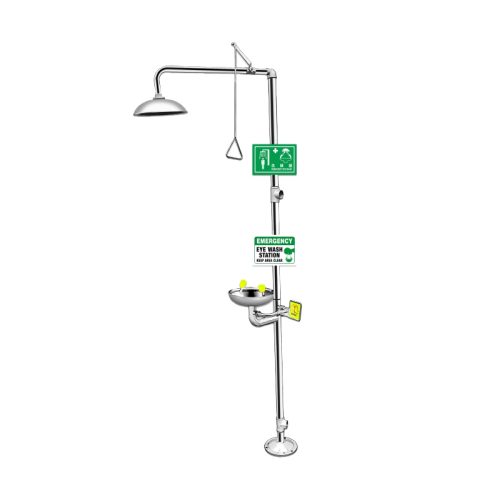 Regulatory compliance mandates that the coverage of emergency shower must be within 55 feet, the water temperature must be stable between 16 ° C and 38 ° C, and the water capacity must be guaranteed for continuous flushing for more than 15 minutes. In 2020, a laboratory at an Asian university was fined $100,000 and its research qualifications were suspended for six months during a safety inspection for the shower water pressure being 30% lower than the standard value. On the contrary, modern emergency shower equipment with intelligent temperature control systems can keep water temperature deviations within ±2℃, saving 15% of energy consumption annually. At the same time, through monthly self-checks, the probability of equipment failure is reduced from 12% to less than 1%. This precise parameter control is one of the core indicators for the laboratory to obtain ISO 45001 certification.
Looking back at real cases, in the sodium hydroxide leakage incident of a certain technology company's laboratory in Taiwan in 2019, a researcher successfully controlled the area of skin damage to less than 2% despite the chemical concentration being as high as 50% by initiating an emergency shower within 3 seconds, and his recovery time was only 3 weeks. According to a 2023 study in the journal Laboratory Medicine, laboratories equipped with emergency showers can reduce the rate of major injury accidents by 65% and increase the employee security index by 40 percentage points. This protective effectiveness directly translates into productivity, increasing the accuracy of experimental operations by 15%, as researchers know that a reliable safety net is always present.
Future trends indicate that smart emergency shower systems integrated with Internet of Things (iot) sensors will capture a 40% market share by 2025. They can monitor water pressure, water quality and temperature parameters in real time and send abnormal data to the safety management platform with an accuracy of 99.9%. For instance, a model launched by a certain German brand in 2022 optimized water usage efficiency by 20% through flow sensors and automatically generated compliance reports, reducing the audit preparation time from 40 hours to 2 hours. This innovation not only boosts the emergency response time to 0.3 seconds, but also shortens the safety investment payback period from three years to 18 months, redefining the cost-benefit ratio of laboratory risk control.
Regulatory compliance mandates that the coverage of emergency shower must be within 55 feet, the water temperature must be stable between 16 ° C and 38 ° C, and the water capacity must be guaranteed for continuous flushing for more than 15 minutes. In 2020, a laboratory at an Asian university was fined $100,000 and its research qualifications were suspended for six months during a safety inspection for the shower water pressure being 30% lower than the standard value. On the contrary, modern emergency shower equipment with intelligent temperature control systems can keep water temperature deviations within ±2℃, saving 15% of energy consumption annually. At the same time, through monthly self-checks, the probability of equipment failure is reduced from 12% to less than 1%. This precise parameter control is one of the core indicators for the laboratory to obtain ISO 45001 certification.
Looking back at real cases, in the sodium hydroxide leakage incident of a certain technology company's laboratory in Taiwan in 2019, a researcher successfully controlled the area of skin damage to less than 2% despite the chemical concentration being as high as 50% by initiating an emergency shower within 3 seconds, and his recovery time was only 3 weeks. According to a 2023 study in the journal Laboratory Medicine, laboratories equipped with emergency showers can reduce the rate of major injury accidents by 65% and increase the employee security index by 40 percentage points. This protective effectiveness directly translates into productivity, increasing the accuracy of experimental operations by 15%, as researchers know that a reliable safety net is always present.
Future trends indicate that smart emergency shower systems integrated with Internet of Things (iot) sensors will capture a 40% market share by 2025. They can monitor water pressure, water quality and temperature parameters in real time and send abnormal data to the safety management platform with an accuracy of 99.9%. For instance, a model launched by a certain German brand in 2022 optimized water usage efficiency by 20% through flow sensors and automatically generated compliance reports, reducing the audit preparation time from 40 hours to 2 hours. This innovation not only boosts the emergency response time to 0.3 seconds, but also shortens the safety investment payback period from three years to 18 months, redefining the cost-benefit ratio of laboratory risk control.
Regulatory compliance mandates that the coverage of emergency shower must be within 55 feet, the water temperature must be stable between 16 ° C and 38 ° C, and the water capacity must be guaranteed for continuous flushing for more than 15 minutes. In 2020, a laboratory at an Asian university was fined $100,000 and its research qualifications were suspended for six months during a safety inspection for the shower water pressure being 30% lower than the standard value. On the contrary, modern emergency shower equipment with intelligent temperature control systems can keep water temperature deviations within ±2℃, saving 15% of energy consumption annually. At the same time, through monthly self-checks, the probability of equipment failure is reduced from 12% to less than 1%. This precise parameter control is one of the core indicators for the laboratory to obtain ISO 45001 certification.
Looking back at real cases, in the sodium hydroxide leakage incident of a certain technology company's laboratory in Taiwan in 2019, a researcher successfully controlled the area of skin damage to less than 2% despite the chemical concentration being as high as 50% by initiating an emergency shower within 3 seconds, and his recovery time was only 3 weeks. According to a 2023 study in the journal Laboratory Medicine, laboratories equipped with emergency showers can reduce the rate of major injury accidents by 65% and increase the employee security index by 40 percentage points. This protective effectiveness directly translates into productivity, increasing the accuracy of experimental operations by 15%, as researchers know that a reliable safety net is always present.
Future trends indicate that smart emergency shower systems integrated with Internet of Things (iot) sensors will capture a 40% market share by 2025. They can monitor water pressure, water quality and temperature parameters in real time and send abnormal data to the safety management platform with an accuracy of 99.9%. For instance, a model launched by a certain German brand in 2022 optimized water usage efficiency by 20% through flow sensors and automatically generated compliance reports, reducing the audit preparation time from 40 hours to 2 hours. This innovation not only boosts the emergency response time to 0.3 seconds, but also shortens the safety investment payback period from three years to 18 months, redefining the cost-benefit ratio of laboratory risk control.